
For the past eight years, I’ve been leveraging (ding) data to develop AI that helps companies become more efficient or increase customers and revenues. I did a semester of AI for my degree but turned my back on AI for the bright lights of Consulting. Fast forward a few years and I’m responsible for AI and data platform deliveries. Even then, even with plain old machine learning, it was clear that AI would have a big impact on work. Fast forward another five years and we’re peering over the edge into a mist. Is it a long way down or an easy jump? Will we land in deep sea-water or impale ourselves on jagged rocks. I’m painting a dramatic picture here but the situation is already quite dramatic. According to McKinsey (“The Economic Potential of Generative AI”) generative AI could automate work activities absorbing 60% to 70% of employees’ time. As Head of Delivery, I was able to create a digital trust team with the dual responsibilities of information security and AI ethics. Back then, I’d say there were fewer than five occasions where we needed to think seriously about whether we should, given that we could. Now, with generative and agentic AI, there’s an ethical consideration almost every time. Oppenheimer struggled in his role leading the Manhattan project but ultimately knew what they had created could not been undone. It would certainly be hyperbole to compare AI with the atomic bomb but it’s right to accept that a technology has been created which has great disruptive, possibly even destructive, power… and can’t be uncreated!
So, there’s no turning back but how to move forward safely, ethically, responsibly.
Back to a previous Consulting life where we advised many clients (banks, airlines, utilities, departments, insurers, …) on anthropocentric technology. It’s a good place to start. Key then was to understand us humans and design digital system around this humanity, taking account of how people work and how we’re motivated. Such an approach is needed now.
Over the past year, I’ve been sharing thoughts on the augmented human – “People Plus”. My inspiration is the P-5000 power loader from Aliens, made famous by Sigourney Weaver’s Ripley. Although bipedal, it had mechanisms to avoid toppling over (stable), greatly increased the operator’s ability to lift (enhanced abilities), was made of reinforced steel (resilient), enclosed Ripley in a harness and roll cage (protection), had an array of finger tip controls (ease of use) and had a hydrogen fuel cell mounted (powered). The loader allowed Ripley to control and finally defeat a Xenomorph – impossible for a normal, un-augmented human.
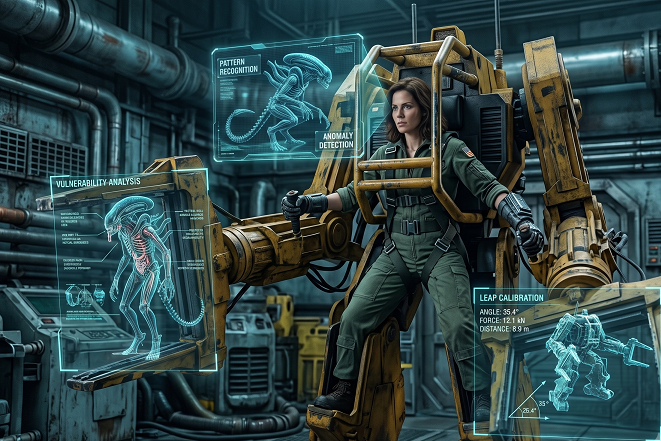
- Resilient
- Stable
- Powered
- Enhanced Abilities
- Operator Protection
- Easy of Use
It just so happens that I have a perfect example of People Plus. Cognitive Data Products (CDPs) combine the “truth” of well engineered and curated data ingestion with the comprehension & creativity of Large Language Models (LLMs). The result is something that provides the customer (be it a person or another agent) almost limitless expertise in a specific business area and a means to access this expertise on demand. Resilience is achieved through the data platform and LLM being utilised as-a-service (well architected) on your cloud platform of choice. Stability is engineered through logging, anomaly detection, auto-scaling and exception management. As well as obviously consuming electricity, CDPs are “powered” by continuous pipelines of streaming data as well as feeds of unstructured content such as policies & standards. Frontier LLMs (Gemini, Claude, …) have excellent in-built categorisation and regression capabilities as well as the innate ability to process huge amounts of structured and unstructured data (Gemini has a context window of at least 1m tokens). This is way beyond the abilities of us humans. Platforms such as Gemini Enterprise and Amazon Bedrock provide configurable guardrails so they can protect us from malicious others and from our own misadventures. Finally, CDPs have a conversational interface – no cumbersome menus, no forgettable commands.
So, Cognitive Data Products are my poster child for People Plus.
More next time.